
Build and evaluate point-in-time graph features#
Goal. Build graph features using only relationships known at payment time, evaluate a small temporal baseline, and optionally convert the graph to PyTorch Geometric.
Prerequisites. Base FraudTwin install. Optional extras and Docker commands are clearly marked.
Produces. A readable graph summary, a temporal feature table, one diagnostic plot, and hold-out metrics.
Source size. The graph fixture generates fewer than 1,000 payments and includes known graph campaigns so the temporal hold-out has labels.
Offline path. All marked offline cells run without Docker or network services. Service cells are optional and explicitly marked in notebook metadata.
Important. The fraud labels below are simulator truth used only for the offline demonstration. In production, replace them with labels that have reached your declared maturity policy.
!pip install torch-geometric matplotlib
Requirement already satisfied: torch-geometric in /home/emc/Projects/test/.venv/lib/python3.14/site-packages (2.8.0.post1)
Requirement already satisfied: matplotlib in /home/emc/Projects/test/.venv/lib/python3.14/site-packages (3.11.2)
Requirement already satisfied: aiohttp in /home/emc/Projects/test/.venv/lib/python3.14/site-packages (from torch-geometric) (3.14.3)
Requirement already satisfied: fsspec in /home/emc/Projects/test/.venv/lib/python3.14/site-packages (from torch-geometric) (2026.9.0)
Requirement already satisfied: jinja2 in /home/emc/Projects/test/.venv/lib/python3.14/site-packages (from torch-geometric) (3.1.6)
Requirement already satisfied: numpy in /home/emc/Projects/test/.venv/lib/python3.14/site-packages (from torch-geometric) (2.5.3)
Requirement already satisfied: psutil>=5.8.0 in /home/emc/Projects/test/.venv/lib/python3.14/site-packages (from torch-geometric) (7.2.2)
Requirement already satisfied: pyparsing in /home/emc/Projects/test/.venv/lib/python3.14/site-packages (from torch-geometric) (3.3.3)
Requirement already satisfied: requests in /home/emc/Projects/test/.venv/lib/python3.14/site-packages (from torch-geometric) (2.34.2)
Requirement already satisfied: tqdm in /home/emc/Projects/test/.venv/lib/python3.14/site-packages (from torch-geometric) (4.70.1)
Requirement already satisfied: xxhash in /home/emc/Projects/test/.venv/lib/python3.14/site-packages (from torch-geometric) (4.0.1)
Requirement already satisfied: contourpy>=1.0.1 in /home/emc/Projects/test/.venv/lib/python3.14/site-packages (from matplotlib) (1.4.0)
Requirement already satisfied: cycler>=0.10 in /home/emc/Projects/test/.venv/lib/python3.14/site-packages (from matplotlib) (0.12.1)
Requirement already satisfied: fonttools>=4.28.2 in /home/emc/Projects/test/.venv/lib/python3.14/site-packages (from matplotlib) (4.66.0)
Requirement already satisfied: kiwisolver>=1.3.1 in /home/emc/Projects/test/.venv/lib/python3.14/site-packages (from matplotlib) (1.5.1)
Requirement already satisfied: packaging>=20.0 in /home/emc/Projects/test/.venv/lib/python3.14/site-packages (from matplotlib) (26.3)
Requirement already satisfied: pillow>=9 in /home/emc/Projects/test/.venv/lib/python3.14/site-packages (from matplotlib) (12.3.0)
Requirement already satisfied: python-dateutil>=2.7 in /home/emc/Projects/test/.venv/lib/python3.14/site-packages (from matplotlib) (2.9.0.post0)
Requirement already satisfied: six>=1.5 in /home/emc/Projects/test/.venv/lib/python3.14/site-packages (from python-dateutil>=2.7->matplotlib) (1.17.0)
Requirement already satisfied: aiohappyeyeballs>=2.5.0 in /home/emc/Projects/test/.venv/lib/python3.14/site-packages (from aiohttp->torch-geometric) (2.7.1)
Requirement already satisfied: aiosignal>=1.4.0 in /home/emc/Projects/test/.venv/lib/python3.14/site-packages (from aiohttp->torch-geometric) (1.4.0)
Requirement already satisfied: attrs>=17.3.0 in /home/emc/Projects/test/.venv/lib/python3.14/site-packages (from aiohttp->torch-geometric) (26.1.0)
Requirement already satisfied: frozenlist>=1.1.1 in /home/emc/Projects/test/.venv/lib/python3.14/site-packages (from aiohttp->torch-geometric) (1.8.0)
Requirement already satisfied: multidict<7.0,>=4.5 in /home/emc/Projects/test/.venv/lib/python3.14/site-packages (from aiohttp->torch-geometric) (6.9.1)
Requirement already satisfied: propcache>=0.2.0 in /home/emc/Projects/test/.venv/lib/python3.14/site-packages (from aiohttp->torch-geometric) (0.5.4)
Requirement already satisfied: yarl<2.0,>=1.17.0 in /home/emc/Projects/test/.venv/lib/python3.14/site-packages (from aiohttp->torch-geometric) (1.25.1)
Requirement already satisfied: idna>=2.0 in /home/emc/Projects/test/.venv/lib/python3.14/site-packages (from yarl<2.0,>=1.17.0->aiohttp->torch-geometric) (3.19)
Requirement already satisfied: MarkupSafe>=2.0 in /home/emc/Projects/test/.venv/lib/python3.14/site-packages (from jinja2->torch-geometric) (3.0.3)
Requirement already satisfied: charset_normalizer<4,>=2 in /home/emc/Projects/test/.venv/lib/python3.14/site-packages (from requests->torch-geometric) (3.5.1)
Requirement already satisfied: urllib3<3,>=1.26 in /home/emc/Projects/test/.venv/lib/python3.14/site-packages (from requests->torch-geometric) (2.7.0)
Requirement already satisfied: certifi>=2023.5.7 in /home/emc/Projects/test/.venv/lib/python3.14/site-packages (from requests->torch-geometric) (2026.7.22)

[notice] A new release of pip is available: 26.1 -> 26.2.1
[notice] To update, run: pip install --upgrade pip
Set up a deterministic source run
import json
from pathlib import Path

import polars as pl

from fraudtwin.config import load_config
from fraudtwin.generation import generate

root = next(
    (p for p in (Path.cwd(), *Path.cwd().parents) if (p / "configs" / "minimal.yaml").exists()),
    Path.cwd(),
)
config = load_config(root / "configs" / "benchmarks" / "graph-v2.yaml")
data = generate(config, write=False)
run_id = data.run_id
payments = pl.DataFrame([item.model_dump(mode="json") for item in data.behavior.payments])
print("Source run")
print(f"  run_id: {run_id}")
print(f"  payments: {len(payments):,}")
print(f"  payment events: {len(data.behavior.payment_events):,}")
print(f"  graph campaigns: {len(data.behavior.graph_campaigns):,}")
Source run
  run_id: RUN-d4fe1230e312957d
  payments: 757
  payment events: 2,642
  graph campaigns: 13
Inspect the graph
The observable view contains nodes and relationships available to a downstream detector. The table below is a compact count by relationship type.
from fraudtwin.graph import build_graph, validate_graph

graph = build_graph(config, data.entities, data.behavior, data.manifest, view="observable")
validate_graph(graph)
nodes, edges = graph.node_frame, graph.edge_frame
print("Observable graph")
print(f"  nodes: {nodes.height:,}")
print(f"  edges: {edges.height:,}")
display(
    edges.group_by("edge_type")
    .len()
    .rename({"len": "edges"})
    .sort("edges", descending=True)
    .head(8)
)
Observable graph
  nodes: 417
  edges: 4,191
| edge_type | edges |
|---|---|
| str | u32 |
| "USES" | 960 |
| "SHARES_DEVICE" | 680 |
| "TRANSFERRED_TO" | 625 |
| "PAID" | 526 |
| "PURCHASED_FROM" | 526 |
| "RECEIVED_FROM" | 488 |
| "OWNS" | 240 |
| "HELD_AT" | 120 |
Build point-in-time features
For every payment, count only incident event edges whose event time and availability are earlier than the payment. This is the leakage-safe feature boundary we will evaluate.
from datetime import timedelta

# Use only event edges observed strictly before each payment.
edge_rows = edges.to_dicts()
truth_ids = {record.payment_id for record in data.behavior.fraud_records if record.fraud_truth}
holdout_at = data.manifest.start_time + timedelta(minutes=40)
feature_rows = []
for payment in data.behavior.payments:
    prior_edges = [
        edge
        for edge in edge_rows
        if edge["event_time"] is not None
        and edge["event_time"] < payment.initiated_at
        and (edge["available_at"] is None or edge["available_at"] <= payment.initiated_at)
        and (edge["valid_to"] is None or payment.initiated_at <= edge["valid_to"])
        and (
            edge["src_id"] == payment.payer_account_id or edge["dst_id"] == payment.payer_account_id
        )
    ]
    counterparties = {
        edge["dst_id"] if edge["src_id"] == payment.payer_account_id else edge["src_id"]
        for edge in prior_edges
    }
    feature_rows.append(
        {
            "payment_id": payment.payment_id,
            "initiated_at": payment.initiated_at,
            "prior_event_edges": len(prior_edges),
            "prior_counterparties": len(counterparties),
            "label": int(payment.payment_id in truth_ids),
            "split": "train" if payment.initiated_at < holdout_at else "test",
        }
    )
features = pl.DataFrame(feature_rows).sort("initiated_at")
print("Point-in-time features")
print(f"  rows: {features.height:,}")
print("  features: prior_event_edges, prior_counterparties")
print(f"  hold-out starts: {holdout_at.isoformat()}")
display(features.head(8))
Point-in-time features
  rows: 757
  features: prior_event_edges, prior_counterparties
  hold-out starts: 2026-01-01T00:40:00+00:00
| payment_id | initiated_at | prior_event_edges | prior_counterparties | label | split |
|---|---|---|---|---|---|
| str | datetime[μs, UTC] | i64 | i64 | i64 | str |
| "PAY-G-MERCHANT_CUSTOMER_COMMUN… | 2026-01-01 00:05:00 UTC | 0 | 0 | 1 | "train" |
| "PAY-00000457" | 2026-01-01 00:06:00 UTC | 0 | 0 | 0 | "train" |
| "PAY-G-DENSE_CAMPAIGN-0011-0000… | 2026-01-01 00:10:00 UTC | 0 | 0 | 1 | "train" |
| "PAY-G-MERCHANT_CUSTOMER_COMMUN… | 2026-01-01 00:10:00 UTC | 0 | 0 | 1 | "train" |
| "PAY-G-MULE_NETWORK-0001-00001" | 2026-01-01 00:15:00 UTC | 0 | 0 | 1 | "train" |
| "PAY-G-CYCLIC_RING-0002-00001" | 2026-01-01 00:15:00 UTC | 0 | 0 | 1 | "train" |
| "PAY-G-BIPARTITE_NETWORK-0005-0… | 2026-01-01 00:15:00 UTC | 0 | 0 | 1 | "train" |
| "PAY-G-STACKED_NETWORK-0006-000… | 2026-01-01 00:15:00 UTC | 0 | 0 | 1 | "train" |
Check the optional PyG representation
PyTorch Geometric is an optional adapter. It changes the representation of the graph; it does not train or evaluate a model by itself.
try:
    from fraudtwin.graph import to_pyg

    pyg = to_pyg(graph)
    print(f"PyG conversion succeeded: {type(pyg).__name__}")
    print(f"  node types: {len(pyg.node_types)}")
    print(f"  edge types: {len(pyg.edge_types)}")
except (ImportError, RuntimeError):
    pyg = None
    print("PyTorch Geometric is optional; using tabular degree features.")
PyTorch Geometric is optional; using tabular degree features.
Visualize the temporal feature signal
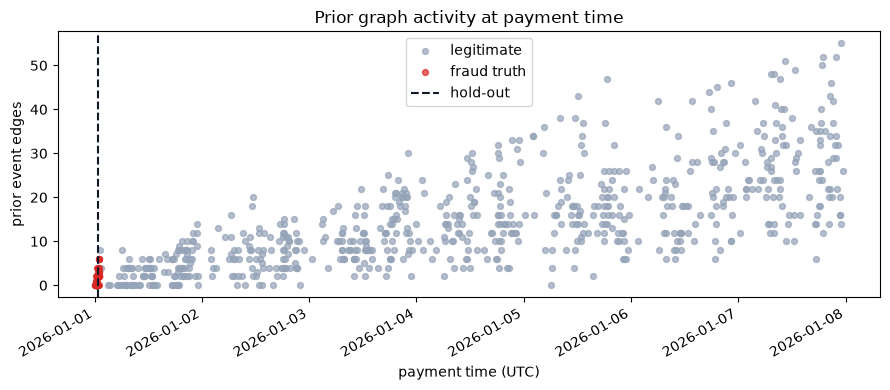
The plot shows prior graph activity at payment time and marks the chronological hold-out boundary. Simulator truth is used only to color the diagnostic points.
try:
    import matplotlib.pyplot as plt

    fig, axis = plt.subplots(figsize=(9, 4))
    for label, name, color in ((0, "legitimate", "#94a3b8"), (1, "fraud truth", "#dc2626")):
        points = features.filter(pl.col("label") == label)
        axis.scatter(
            points["initiated_at"].to_list(),
            points["prior_event_edges"].to_list(),
            s=18,
            alpha=0.7,
            label=name,
            color=color,
        )
    axis.axvline(holdout_at, color="#111827", linestyle="--", label="hold-out")
    axis.set(
        title="Prior graph activity at payment time",
        xlabel="payment time (UTC)",
        ylabel="prior event edges",
    )
    axis.legend()
    fig.autofmt_xdate()
    fig.tight_layout()
    plt.show()
    plt.close(fig)
except ImportError:
    print("Install matplotlib to render the graph feature plot.")

display(
    features.select(["payment_id", "prior_event_edges", "prior_counterparties", "split"]).head(8)
)
| payment_id | prior_event_edges | prior_counterparties | split |
|---|---|---|---|
| str | i64 | i64 | str |
| "PAY-G-MERCHANT_CUSTOMER_COMMUN… | 0 | 0 | "train" |
| "PAY-00000457" | 0 | 0 | "train" |
| "PAY-G-DENSE_CAMPAIGN-0011-0000… | 0 | 0 | "train" |
| "PAY-G-MERCHANT_CUSTOMER_COMMUN… | 0 | 0 | "train" |
| "PAY-G-MULE_NETWORK-0001-00001" | 0 | 0 | "train" |
| "PAY-G-CYCLIC_RING-0002-00001" | 0 | 0 | "train" |
| "PAY-G-BIPARTITE_NETWORK-0005-0… | 0 | 0 | "train" |
| "PAY-G-STACKED_NETWORK-0006-000… | 0 | 0 | "train" |
Evaluate the temporal baseline
This is a deliberately small structural baseline, not a trained GNN. The metrics confirm that the feature table, label alignment, and chronological split are all real before a more complex graph model is introduced.
from sklearn.metrics import average_precision_score, roc_auc_score

from fraudtwin.reproducibility import sha256_json

train = features.filter(pl.col("split") == "train")
test = features.filter(pl.col("split") == "test")
test_labels = test["label"].to_numpy()
# This deliberately simple score is a baseline, not a trained GNN.
graph_scores = test["prior_event_edges"].to_numpy()
metrics = {
    "baseline": "prior event degree",
    "train_rows": train.height,
    "test_rows": test.height,
    "test_positive_labels": int(test["label"].sum()),
    "roc_auc": round(float(roc_auc_score(test_labels, graph_scores)), 3),
    "pr_auc": round(float(average_precision_score(test_labels, graph_scores)), 3),
}
print("Temporal baseline")
for name, value in metrics.items():
    print(f"  {name}: {value}")
print(f"  feature fingerprint: {sha256_json(features.to_dicts())[:12]}...")
Temporal baseline
  baseline: prior event degree
  train_rows: 28
  test_rows: 729
  test_positive_labels: 28
  roc_auc: 0.098
  pr_auc: 0.027
  feature fingerprint: ef858278a7c7...
Verify the temporal boundary
These assertions make the important tutorial claim executable: training rows precede test rows, and the test window contains both labels.
assert graph.output_fingerprint
assert train["initiated_at"].max() < test["initiated_at"].min()
assert test["label"].n_unique() == 2
print("Verified: features use only earlier available event edges.")
print("Verified: the test window contains both labels.")
Verified: features use only earlier available event edges.
Verified: the test window contains both labels.
Inspect a few source rows
# A compact inspection is more useful than printing an entire run.
sample_columns = [
    c for c in ("payment_id", "amount", "initiated_at", "payer_account_id") if c in payments.columns
]
sample_rows = payments.select(sample_columns).head(8).to_dicts()
print(f"Sample payments ({len(sample_rows)} of {payments.height} rows):")
for row in sample_rows:
    print(
        f"  - {row.get('payment_id')}: amount={row.get('amount')}, "
        f"initiated_at={row.get('initiated_at')}, payer={row.get('payer_account_id')}"
    )
nulls = {name: count for name, count in payments.null_count().to_dicts()[0].items() if count}
print("\nData quality summary:")
print(f"  rows: {payments.height}")
print(f"  columns: {payments.width}")
if not nulls:
    print("  nulls: none")
else:
    print("  columns with nulls:")
    for name, count in sorted(nulls.items()):
        print(f"    - {name}: {count}")
Sample payments (8 of 757 rows):
  - PAY-00000001: amount=16.48, initiated_at=2026-01-03T22:42:00Z, payer=ACC-000028
  - PAY-00000002: amount=50.72, initiated_at=2026-01-02T21:42:00Z, payer=ACC-000104
  - PAY-00000003: amount=10.0, initiated_at=2026-01-01T13:14:00Z, payer=ACC-000055
  - PAY-00000004: amount=393.98, initiated_at=2026-01-06T14:22:00Z, payer=ACC-000088
  - PAY-00000005: amount=14.33, initiated_at=2026-01-05T13:22:00Z, payer=ACC-000042
  - PAY-00000006: amount=10.0, initiated_at=2026-01-05T18:51:00Z, payer=ACC-000055
  - PAY-00000007: amount=19.03, initiated_at=2026-01-07T18:14:00Z, payer=ACC-000099
  - PAY-00000008: amount=20.44, initiated_at=2026-01-05T12:47:00Z, payer=ACC-000080

Data quality summary:
  rows: 757
  columns: 15
  columns with nulls:
    - card_id: 500
    - merchant_id: 488
    - payee_account_id: 12
    - payee_pix_key_id: 620
    - payer_pix_key_id: 620
Review the run manifest
summary = {
    "run_id": run_id,
    "payments": len(data.behavior.payments),
    "payment_events": len(data.behavior.payment_events),
    "graph_campaigns": len(data.behavior.graph_campaigns),
    "fraud_records": len(data.behavior.fraud_records),
}
assert summary["payments"] == len(payments)
assert summary["payments"] > 0
print(json.dumps(summary, indent=2, default=str))
{
  "run_id": "RUN-d4fe1230e312957d",
  "payments": 757,
  "payment_events": 2642,
  "graph_campaigns": 13,
  "fraud_records": 57
}
Optional next step: convert to PyG
Install the optional extra and rerun the final cell to inspect the typed PyG representation. A real GNN should be added only after establishing a stronger baseline and a production label policy.
try:
    from fraudtwin.graph import to_pyg

    pyg_data = to_pyg(graph)
    print(
        {
            "converted": True,
            "num_nodes": int(pyg_data.num_nodes),
            "node_types": len(pyg_data.node_types),
            "edge_types": len(pyg_data.edge_types),
        }
    )
except Exception as exc:
    print({"converted": False, "offline_fallback": True, "reason": type(exc).__name__})
{'converted': False, 'offline_fallback': True, 'reason': 'RuntimeError'}
assert graph.output_fingerprint
print({"offline_fallback": True, "graph_fingerprint": f"{graph.output_fingerprint}"})
{'offline_fallback': True, 'graph_fingerprint': 'db71520b71c00732be5357a67a93a9a643a141afc5ad214e3219bf761675f5f7'}