
Data, domain, and concept shift#
Level: Intermediate
You will: distinguish changes in inputs, populations, labels, and model
performance, then produce reproducible drift evidence.
Before you start: a point-in-time dataset and the ML evaluation
guide.
Services: None; MLflow is optional.
FraudTwin can compare a stable reference window with a later production or
stress window using fraudtwin.ml.drift.
from fraudtwin.ml.drift import DriftConfig, compare_performance, compare_windows

report = compare_windows(
    reference_rows,
    production_rows,
    DriftConfig(
        reference_name="training",
        comparison_name="production-week-4",
        fields=("amount", "payment_rail", "merchant_category", "label"),
    ),
)
print(report.fingerprint)
for metric in report.alerts:
    print(metric.field, metric.method, metric.comparison_value)
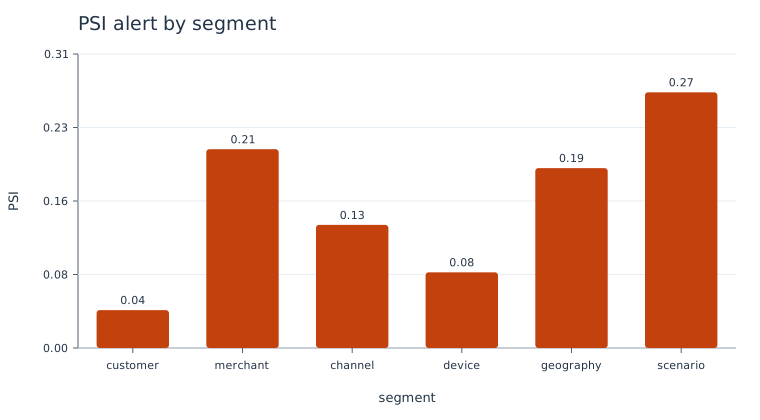
Figure: deterministic segment alert summary from the drift workflow (seed 42; bounded synthetic windows).
Interpret the metrics by asking which distribution changed:
Question |
Meaning |
Typical response |
|---|---|---|
Did feature values change? |
Data drift, |
inspect source, missingness, or feature logic |
Did customer/merchant/channel mix change? |
Domain shift |
evaluate slices and recalibrate sampling |
Did fraud prevalence or conditional outcomes change? |
Concept drift, |
retrain, recalibrate, or redesign features |
Did the same model score worse? |
Performance drift |
investigate threshold, labels, and attack mix |
Numeric reports include reference-fitted PSI bins and empirical Wasserstein distance. Categorical reports include Jensen–Shannon divergence. Reports also include missingness, duplicate-rate, sample-size, prevalence, input fingerprints, thresholds, and label policy. Do not treat an alert as proof of model failure until mature labels and the relevant business slice are present.
Use the temporal and public benchmark packs to create controlled shifts, then compare the exact same metric definitions and thresholds across windows.
Window and sample policy#
Choose a reference window that represents the data used to train or approve the model. The comparison window must use the same feature definitions and the same unit of analysis. Persist both fingerprints and the time boundaries. Do not compare a matured-label training window with an immature production window and call the result performance drift.
Minimum sample sizes and smoothing are part of DriftConfig. Small samples
should produce an informational result or an explicit insufficient-sample
status, not a high-severity alert based on unstable bins. Segment reports must
include segment counts; a high PSI on a segment with very few rows is a review
signal, not proof of a population change.
Alert interpretation and action#
Evidence |
Likely interpretation |
Recommended action |
|---|---|---|
PSI/Wasserstein alert with stable labels |
Data drift |
Inspect ingestion, feature logic, and missingness |
Merchant/customer/channel mix changes |
Domain shift |
Re-evaluate slices and sampling assumptions |
Prevalence or conditional outcomes change |
Concept drift |
Recalibrate, retrain, or redesign features |
Same policy performs worse on mature labels |
Performance drift |
Check attack mix, threshold, latency, and label policy |
Unresolved-label rate increases |
Label delay |
Defer promotion/retraining decisions |
Use severity based on magnitude, sample size, business impact, and persistence across windows. A single alert should open an investigation; it should not automatically retrain a model without a promotion policy and an approved evaluation window.
Segment and multiple-alert policy#
Compare customer cohort, merchant, channel, device, geography, and scenario segments only when the segment key is available at prediction time. Record the number of segments tested and the minimum segment size. For many simultaneous segments, expect false positives: prioritize alerts that are large, persistent, business-critical, or corroborated by performance drift.
Reproducible response#
Store the drift report, configuration, reference/comparison fingerprints, thresholds, sample counts, label policy, and model/evaluation fingerprint. A reproducible response is:
freeze the affected windows;
rerun the report with the same policy;
inspect data-quality and domain-mix evidence;
evaluate mature labels with the unchanged threshold policy;
choose investigation, recalibration, retraining, or no action;
record the decision and next review window.
Next#
Use Model lifecycle when a drift decision changes the model artifact or serving process.