
Kafka reliability and event-time correctness#
Level: Expert
You will: reason about delivery semantics, event time, contracts,
deduplication, retries, and bounded failure exercises.
Before you start: the Integration runbooks and Docker.
Services: Kafka and Schema Registry for broker checks; the logical chaos
path is offline.
FraudTwin’s Kafka publisher is intentionally explicit about contract versions, partition keys, idempotence, retries, acknowledgements, and pacing. The chaos harness adds deterministic logical-message faults around either boundary:
For the optional broker-backed path, install the client and start the local profile:
!pip install confluent-kafka
docker compose --profile streaming up -d kafka schema-registry streaming-topics
The publication tutorials then list broker topics, list Schema Registry subjects, and publish a contract-backed record. The cells use short timeouts; when the broker is unavailable they continue with the deterministic chaos path.
from pathlib import Path

from fraudtwin import generate
from fraudtwin.config import load_config
from fraudtwin.kafka import publication_records
from fraudtwin.kafka_chaos import KafkaChaosConfig, simulate_delivery

written_run = generate(
    load_config(Path("configs/minimal.yaml")),
    write=True,
    output_dir=Path("runs"),
)
data = written_run.load_data()
records = publication_records(data.behavior, written_run.run_id)
result = simulate_delivery(
    records,
    KafkaChaosConfig(
        boundary="producer",
        seed=17,
        drop_probability=0.02,
        duplicate_probability=0.03,
        retry_probability=0.05,
        max_delay_seconds=30,
        reorder_window=100,
        partition_count=3,
    ),
)
print(result.manifest)
Supported logical failures include:
Fault |
What it teaches |
|---|---|
drop/outage |
loss handling and reconciliation |
duplicate/retry |
idempotent consumers and stable event IDs |
delay/late delivery |
event-time windows and watermarks |
reordering |
separating business time from arrival order |
partition skew |
hot partitions and consumer imbalance |
schema change |
compatibility checks and reader defaults |
event_id, business keys, and payload bytes are preserved. A chaos manifest
reports input/output fingerprints, attempts, transport IDs, topic/partition
counts, and deduplicated totals. This simulates Kafka message semantics, not
physical network packets; use Docker/Linux tc/netem separately when testing
socket-level failures.
Event-flow semantics#
The observable publication path is:
source run → contract validation → topic/partition assignment → producer acknowledgement → consumer processing → deduplication → event-time projection
The six observable topics use payment_id as the partition key. Ordering is
guaranteed only within a topic and key; arrival order is not business event
time. Producers use idempotence and acknowledgements, but process restarts can
still produce at-least-once delivery. Consumers must deduplicate by stable
event_id (or the documented business identity for a subject) before applying
side effects.
Concern |
FraudTwin guidance |
|---|---|
Offsets |
Commit only after validation and idempotent projection |
Retries |
Preserve event identity and increment transport attempt metadata |
Dead-letter records |
Retain the original payload, error, topic, partition, and offset |
Event time |
Use |
Watermarks |
Advance only according to the chosen lateness policy |
Schema changes |
Validate reader defaults and full-transitive compatibility before send |
Replay |
Reprocess a bounded source interval without rewriting source truth |
Reliability report#
The deterministic recovery summary is generated from bounded tutorial data; it is evidence for the logical fault model, not a packet-loss benchmark.
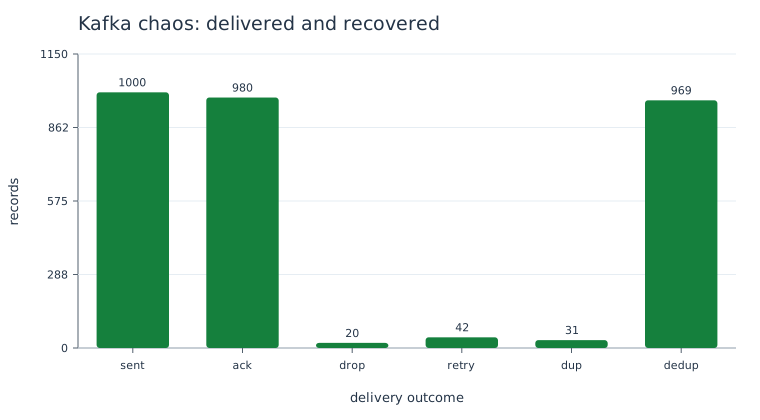
Figure: logical-message recovery counts generated by the Kafka chaos workflow; it does not represent physical network loss.
Every chaos or broker-backed exercise should report the following counts in one table:
Counter |
Definition |
|---|---|
Sent |
Input logical records offered to the boundary |
Acknowledged |
Records accepted by the producer boundary |
Dropped/lost |
Records intentionally not delivered |
Retried |
Additional attempts for the same logical record |
Duplicated |
Additional delivered envelopes for an identity |
Late |
Delivered after the configured event-time lateness policy |
Reordered |
Records whose delivery order differs from source order |
Deduplicated |
Duplicate envelopes removed before projection |
Lag |
Processing or delivery time minus event time |
Always include input/output fingerprints and topic/partition counts. A lower duplicate rate after deduplication is not evidence that the producer was exactly-once; it only shows that the consumer projection was idempotent.
MLOps checklist#
verify topic and schema versions before deployment;
set explicit acknowledgements, idempotence, retry, and timeout policies;
monitor consumer lag, rebalance frequency, duplicate rate, invalid records, late-event rate, and dead-letter volume;
test an outage with drop, delay, and buffer-and-flush behavior;
replay a bounded interval and reconcile stable event IDs;
document the watermark and acceptable lateness policy;
keep broker credentials and registry credentials outside configuration files;
test schema evolution before registering a producer or consumer revision.
Researchers can run the same logic with simulate_delivery and no broker;
the offline result is suitable for deterministic tests and teaching, but it is
not a substitute for socket-level failure testing or broker capacity testing.
For broker configuration, security, capacity, and production operations, use the Confluent Kafka Python documentation and Schema Registry documentation.
Next#
Use Spark Structured Streaming for bounded downstream processing, or return to Data-quality incidents for offline fault repair.