
Graph and benchmark workflows#
Level: Intermediate
You will: export temporal graph views, compare benchmark conditions, and
interpret quality results without confusing N/A with a zero score.
Before you start: a generated run and Concepts.
Services: None for local exports; Neo4j and optional model packages are
available for integration paths.
Graph campaigns add relationships to the same payment and event identities already present in a run. They do not create a separate synthetic universe.
Export graph views#
This compact visual is generated from the graph tutorial’s observable/oracle comparison and keeps benchmark evidence separate from latent truth.
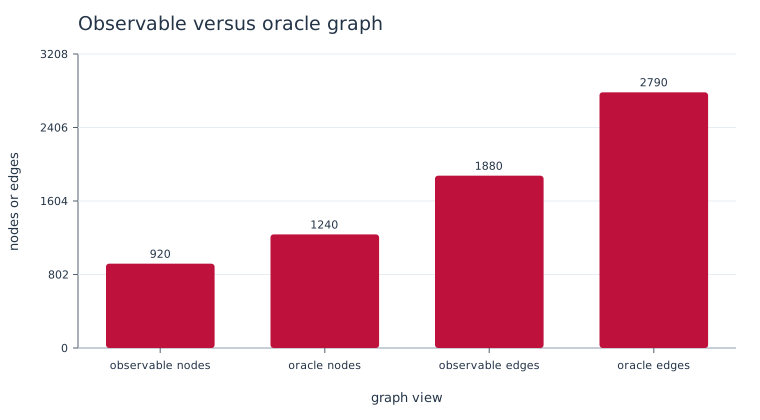
Figure: observable versus oracle graph evidence from a bounded graph fixture; source workflow: the observable/oracle investigation tutorial.
Enable a graph.scenarios list in a new run, or use the versioned graph fixture:
CONFIG=configs/benchmarks/graph-v2.yaml
RUN_ID=RUN-...
RUNS_DIR=./runs
GRAPH_DIR=./runs/graphs

poetry run fraudtwin generate "$CONFIG" --output-dir "$RUNS_DIR"
poetry run fraudtwin graph export \
  --run-id "$RUN_ID" \
  --output-dir "$GRAPH_DIR" \
  --format parquet,neo4j \
  --json
The exporter is read-only. Observable graphs contain only relationships supported by source events and available at the selected cutoff. Oracle graphs also contain campaign membership, patterns, evidence, and optional hyperedge incidence records. Neo4j output is dependency-free CSV/Cypher; PyTorch Geometric output is optional (poetry install -E graph).
Validate both graph structure and provenance when working with a fixture:
poetry run fraudtwin graph validate \
  --run-id "$RUN_ID" \
  --output-dir "$RUNS_DIR"
Difficulty benchmarks#
Difficulty levels run from obvious to subtle. They adjust measurable controls such as fraud/legitimate overlap, behavioral deviation, hard-negative noise, prevalence, temporal irregularity, and graph structural subtlety while keeping the scenario objective and topology intact.
CONFIG=configs/benchmarks/difficulty-v1.yaml
RUNS_DIR=./runs

poetry run fraudtwin generate "$CONFIG" --output-dir "$RUNS_DIR"
The resolved profile, transformations, effective hash, and measured summaries are recorded in the source, dataset, and graph manifests. Active operational events omit direct scenario linkage; oracle artifacts retain it.
Camouflage stress#
Camouflage makes fraud look more like legitimate activity without changing the underlying truth. Feature camouflage affects amount, timing, merchant, device, geography, and frequency. Relation camouflage adds ordinary support payments and graph relationships while leaving campaign membership and induced fraud topology unchanged.
CONFIG=configs/benchmarks/camouflage-v1.yaml
RUNS_DIR=./runs

poetry run fraudtwin generate "$CONFIG" --output-dir "$RUNS_DIR"
Requested and effective strengths, cohort snapshots, constraints, and measured observable/oracle summaries are recorded in manifests. Geography is represented through valid customer and merchant choices because the payment schema has no standalone geography field. Requests that exceed available capacity are capped or redirected deterministically and recorded as constraints.
Advanced campaign dynamics#
Campaign dynamics evolve matching graph campaigns in stable campaign order. Phase snapshots and transitions use isolated per-campaign streams, and derived payments receive reserved IDs with source lineage. Actor joins/leaves, mule and device rotation, cross-rail movement, split/merge mutations, and structural hyperedges remain closed over the oracle graph. Observable graph views use only source-available events; dynamic truth and transition reasons remain oracle-only.
Choosing a fixture#
Fixture |
Best for |
|---|---|
|
Temporal splits, replay, and rolling backtests |
|
Graph structure, observable/oracle views, and exports |
|
Boundary-oriented fraud difficulty |
|
Feature and relation camouflage |
Reference calibration can be combined with graph fixtures when the reference contains transfer endpoints. Graph calibration contributes aggregate degree and motif summaries only; configured graph topology and graph closure remain authoritative. Campaign summaries are available when the reference supplies a campaign identifier and campaign dynamics are enabled.
Treat these files as immutable examples. Copy one into a working configuration when you need to explore a variation; do not edit the versioned fixture in place.
Run the fraud stress benchmark#
The benchmark command packages the deterministic stress dimensions into standard suites and writes a PIT-safe dataset, latent/observed truth catalog, descriptors, fixed split lineage, and comparable model results:
poetry run fraudtwin benchmark --suite mixed --difficulty 7 --seed 42 \
  --calibration-profile profiles/reference.yaml
poetry run fraudtwin benchmark --suite all --difficulty 7 --seed 42
The built-in dependency-free heuristic always runs. Optional scikit-learn,
LightGBM, XGBoost, and CatBoost models are selected with --models after
installing the optional ML extra:
poetry install -E ml
poetry run fraudtwin benchmark --suite graph \
  --models deterministic_heuristic --models xgboost
External runners use a module:factory adapter and may use any framework,
including PyTorch, TensorFlow/Keras, JAX/Flax, PyTorch Geometric, or another
scikit-learn-compatible environment. The runner receives only observable PIT
artifacts and must return the canonical prediction records; framework
dependencies remain outside FraudTwin’s core installation.
Each benchmark manifest records the generator and suite versions, seed, scenario mix, resolved stress controls, calibration identity, label-observation policy, temporal ranges, ground-truth availability rules, model lineage, and output fingerprints. Model scoring uses the isolated synthetic truth as its complete target while keeping the PIT feature set observable; operational label observations remain delayed and incomplete in the generated dataset.
Run an immutable public benchmark pack#
The public benchmark catalog bundles eight named packs whose generation controls, PIT windows, metrics, calibration identity, descriptors, and logical content fingerprints are frozen in the installed package:
fraudtwin benchmark run FT-B04-CAMOUFLAGE@0.34.0
fraudtwin benchmark describe FT-B04-CAMOUFLAGE@0.34.0
fraudtwin benchmark verify runs/benchmarks/BM-<id>
The shorthand @0.34 is accepted only when it resolves to one patch version.
Pack runs reject incompatible FraudTwin versions, altered definitions, and
logical output drift. benchmark verify checks an existing artifact without
rerunning it. Released definitions are never edited or removed; a
change to seeds, scenarios, splits, metrics, label policy, or calibration
creates a new pack version, while prior versions remain runnable.
The legacy fraudtwin.ml.BenchmarkPack fixtures remain supported for backtests
over an existing generated run and are separate from these public packs.
Generator-quality benchmark#
The quality benchmark evaluates the generator itself rather than a fraud model. The standard profile runs every immutable public pack and reports correctness, statistical/temporal/graph fidelity, fraud difficulty, scalability, engineering performance, and reproducibility independently:
poetry run fraudtwin quality-benchmark --profile standard-v1
poetry run fraudtwin report RUN-<id>
Scalability metrics are populated from an explicitly executed scale job; this keeps large workloads out of normal quality runs. Pass its evidence manifest to the matching profile:
poetry run fraudtwin quality-benchmark \
  --profile standard-v1-dev \
  --scale-manifest runs/scale-benchmarks/<run>-benchmark.json
The default profile uses the small workload. The immutable
standard-v1-medium, standard-v1-large, standard-v1-xlarge, and
standard-v1-billion profiles are opt-in and require documented hardware.
External generators can be supplied as a module:factory adapter or a
normalized artifact bundle. A capability that is not supplied is reported as
N/A, never as a zero score.
Next#
Move to Data and evaluation workflows for model comparison, or to Integration runbooks for service-backed graph workflows.