
Detect data, domain, and concept shift#
Goal. Distinguish feature, domain, concept, and performance changes with deterministic evidence.
Prerequisites. Base install; optional ML extra for richer evaluation.
Produces. Drift metrics, a segment-mix table, performance comparisons, and a report fingerprint.
Source size. The default cells generate approximately 1,000 logical payments; increase duration and population together for a 10,000-payment run.
Offline path. All marked offline cells run without Docker or network services. Service cells are optional and explicitly marked in notebook metadata.
Cleanup. Outputs are written under a temporary directory; remove any local run directory if you changed the output location.
Set up a deterministic source run
from pathlib import Path
from tempfile import TemporaryDirectory

import polars as pl

from fraudtwin.config import load_config
from fraudtwin.generation import generate

root = next(
    (p for p in (Path.cwd(), *Path.cwd().parents) if (p / "configs" / "minimal.yaml").exists()),
    Path.cwd(),
)
base = load_config(root / "configs" / "minimal.yaml")
# Scale the population so the bounded example produces about 1,000 payments.
population = base.population.model_copy(
    update={
        "customers": 200,
        "accounts": 300,
        "cards": 240,
        "devices": 240,
        "pix_keys": 160,
        "merchants": 60,
    }
)
simulation = base.simulation.model_copy(update={"duration_days": 10})
fraud = base.fraud.model_copy(update={"enabled": True, "target_rate": 0.05})
config = base.model_copy(
    update={"population": population, "simulation": simulation, "fraud": fraud}
)
data = generate(config, write=False)
run_id = data.run_id
payments = pl.DataFrame([item.model_dump(mode="json") for item in data.behavior.payments])
print({"run_id": run_id, "payments": len(payments), "events": len(data.behavior.payment_events)})
{'run_id': 'RUN-2a3ad02ee370aeb8', 'payments': 1092, 'events': 4699}
Inspect schema, grain, and counts
from fraudtwin.ml.drift import DriftConfig, compare_windows

reference = payments.to_dicts()
comparison = [
    dict(row, amount=float(row.get("amount") or 0) * 1.25, channel="shifted") for row in reference
]
drift_config = DriftConfig(
    reference_name="reference",
    comparison_name="comparison",
    minimum_samples=1,
    fields=("amount", "channel"),
)
report = compare_windows(reference, comparison, drift_config)
print(
    {
        "reference": report.reference_count,
        "comparison": report.comparison_count,
        "fingerprint": f"{report.fingerprint[:12]}...",
    }
)
{'reference': 1092, 'comparison': 1092, 'fingerprint': '43afac66e7b6...'}
Run the core operation
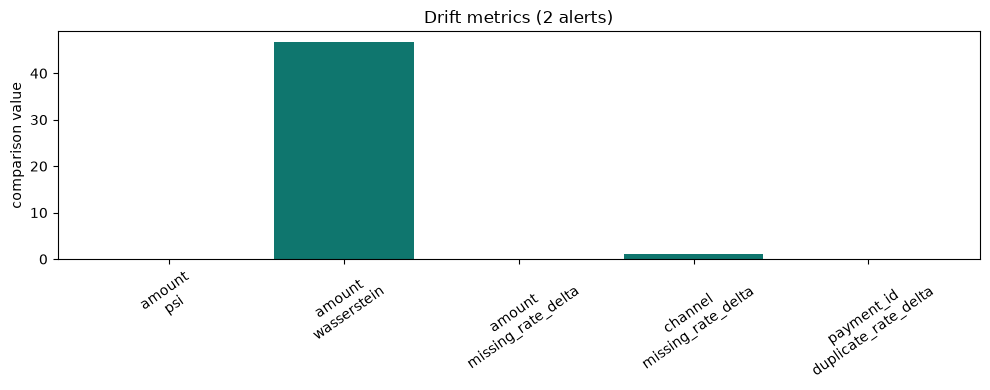
metrics = pl.DataFrame([metric.model_dump(mode="json") for metric in report.metrics])
display(metrics)
try:
    import matplotlib.pyplot as plt

    plot_metrics = metrics.filter(pl.col("comparison_value").is_not_null())
    labels = [
        f"{field}\n{method}"
        for field, method in plot_metrics.select(["field", "method"]).iter_rows()
    ]
    fig, axis = plt.subplots(figsize=(10, 4))
    axis.bar(labels, plot_metrics["comparison_value"].to_list(), color="#0f766e")
    axis.set(title=f"Drift metrics ({len(report.alerts)} alerts)", ylabel="comparison value")
    axis.tick_params(axis="x", labelrotation=35)
    fig.tight_layout()
    plt.show()
    plt.close(fig)
except ImportError:
    print("Install matplotlib to render the drift-metrics plot.")
| field | field_type | method | reference_value | comparison_value | threshold | alerted | reference_count | comparison_count | metadata |
|---|---|---|---|---|---|---|---|---|---|
| str | str | str | f64 | f64 | f64 | bool | i64 | i64 | struct[3] |
| "amount" | "numeric" | "psi" | 0.0 | 0.032106 | 0.2 | false | 1092 | 1092 | {10,[1.0, 4.521, … 4854.42],null} |
| "amount" | "numeric" | "wasserstein" | 0.0 | 46.69236 | 0.1 | true | 1092 | 1092 | {null,null,null} |
| "amount" | "quality" | "missing_rate_delta" | 0.0 | 0.0 | 0.05 | false | 1092 | 1092 | {null,null,null} |
| "channel" | "categorical" | "jensen_shannon" | 0.0 | null | 0.1 | false | 0 | 1092 | {null,null,null} |
| "channel" | "quality" | "missing_rate_delta" | 1.0 | 1.0 | 0.05 | true | 1092 | 1092 | {null,null,null} |
| "payment_id" | "quality" | "duplicate_rate_delta" | 0.0 | 0.0 | 0.05 | false | 1092 | 1092 | {null,null,0.0} |
Measure and interpret the result
segment = (
    payments.group_by([c for c in ("merchant_id", "payer_account_id") if c in payments.columns])
    .len()
    .sort("len", descending=True)
    .head(10)
)
display(segment)
print("domain shift means the population mix changed; it is not automatically model failure")
| merchant_id | payer_account_id | len |
|---|---|---|
| str | str | u32 |
| null | "ACC-000021" | 14 |
| null | "ACC-000112" | 13 |
| null | "ACC-000167" | 12 |
| null | "ACC-000245" | 10 |
| null | "ACC-000096" | 10 |
| null | "ACC-000172" | 10 |
| null | "ACC-000062" | 9 |
| null | "ACC-000288" | 9 |
| null | "ACC-000052" | 9 |
| null | "ACC-000271" | 9 |
domain shift means the population mix changed; it is not automatically model failure
Exercise a parameter or failure mode
from fraudtwin.ml.drift import compare_performance

performance = compare_performance(
    {"pr_auc": 0.42, "recall_at_fpr_1pct": 0.30},
    {"pr_auc": 0.31, "recall_at_fpr_1pct": 0.20},
    config=drift_config,
    label_policy="exclude_unresolved",
)
display(pl.DataFrame([metric.model_dump(mode="json") for metric in performance]))
| field | field_type | method | reference_value | comparison_value | threshold | alerted | reference_count | comparison_count | metadata |
|---|---|---|---|---|---|---|---|---|---|
| str | str | str | f64 | f64 | f64 | bool | i64 | i64 | struct[2] |
| "pr_auc" | "performance" | "absolute_metric_delta" | 0.42 | 0.11 | 0.05 | true | 1 | 1 | {0.31,"exclude_unresolved"} |
| "recall_at_fpr_1pct" | "performance" | "absolute_metric_delta" | 0.3 | 0.1 | 0.05 | true | 1 | 1 | {0.2,"exclude_unresolved"} |
Write a compact artifact and fingerprint
with TemporaryDirectory(prefix="fraudtwin-drift-") as temporary_dir:
    path = Path(temporary_dir) / "drift-report.json"
    path.write_text(report.model_dump_json(indent=2), encoding="utf-8")
    print("Drift report")
    print(f"  file: {path.name}")
    print(f"  size: {path.stat().st_size:,} bytes")
    print("  lifecycle: temporary; removed when this cell exits")
    print("  next step: investigate alerts before retraining")
Drift report
  file: drift-report.json
  size: 3,121 bytes
  lifecycle: temporary; removed when this cell exits
  next step: investigate alerts before retraining
Verify invariants and clean up
summary = {
    "run_id": run_id,
    "payments": len(data.behavior.payments),
    "payment_events": len(data.behavior.payment_events),
    "fraud_records": len(data.behavior.fraud_records),
}
assert summary["payments"] == len(payments)
assert summary["payments"] > 0
summary_table = pl.DataFrame(
    [{"metric": key, "value": str(value)} for key, value in summary.items()]
)
print(summary_table)
shape: (4, 2)
┌────────────────┬──────────────────────┐
│ metric         ┆ value                │
│ ---            ┆ ---                  │
│ str            ┆ str                  │
╞════════════════╪══════════════════════╡
│ run_id         ┆ RUN-2a3ad02ee370aeb8 │
│ payments       ┆ 1092                 │
│ payment_events ┆ 4699                 │
│ fraud_records  ┆ 51                   │
└────────────────┴──────────────────────┘
Record the generated shape and tutorial contract.#
summary = {
    "payments": len(data.behavior.payments),
    "events": len(data.behavior.payment_events),
}
print(summary)
assert summary["payments"] >= 0
{'payments': 1092, 'events': 4699}
Inspect stable payment identities.#
ids = [item.payment_id for item in data.behavior.payments]
assert len(ids) == len(set(ids))
print({"unique_payment_ids": len(ids)})
{'unique_payment_ids': 1092}
Record the generated shape and tutorial contract.#
summary = {
    "payments": len(data.behavior.payments),
    "events": len(data.behavior.payment_events),
}
print(summary)
assert summary["payments"] >= 0
{'payments': 1092, 'events': 4699}