
Integration runbooks#
Level: Expert
You will: connect optional services while keeping Parquet artifacts,
contracts, credentials, and reconciliation visible.
Before you start: the Architecture guide and Docker
basics.
Services: Depends on the integration; every section identifies its local
fallback.
FraudTwin’s core generator is offline and deterministic. These runbooks cover optional local integrations for MLOps and data-engineering workflows. Every service-backed path has an offline notebook or manifest-based fallback.
Integration map#
Integration |
Extra/client |
Start locally |
First health check |
Offline fallback |
|---|---|---|---|---|
Kafka + Schema Registry |
|
|
broker metadata and |
|
Spark Structured Streaming |
external Spark 3.5 runtime |
|
|
local Parquet batch generation |
PostgreSQL |
|
|
|
local Parquet manifest |
Iceberg + MinIO |
|
|
catalog namespaces and object-store health |
Bronze/Silver/Gold local projections |
Neo4j |
|
|
Bolt connectivity and |
Cypher files and local graph frames |
MLflow |
|
local file tracking or MLflow server |
tracked run metadata |
local model metadata |
FastAPI |
|
|
|
offline prediction replay |
Prometheus/Grafana |
|
|
Prometheus target health |
manifest SLO table |
The tutorial notebooks use the same client commands as this table. Full installation, authentication, TLS, clustering, backup, and production sizing remain the responsibility of the service vendor. See the official manuals for Neo4j, Confluent Kafka, PostgreSQL, PyIceberg, MLflow, FastAPI, and Prometheus.
Common operating sequence#
The reconciliation figure shows the compact evidence produced by the offline lakehouse and database paths before a service is available.
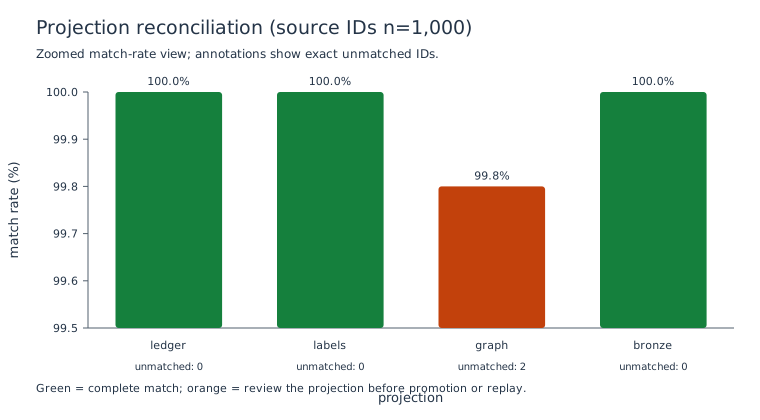
Figure: reconciliation evidence from the offline integration path, generated with seed 42. The match-rate axis is intentionally zoomed to 99.5–100%; exact unmatched counts are printed below each bar. The graph projection has two IDs requiring review while the other projections pass.
Install the matching extra.
Start the documented service profile.
Export credentials and endpoints through environment variables.
Run the service health check before generation.
Keep Parquet enabled as the deterministic source artifact.
Generate or publish a bounded run.
Verify row counts, fingerprints, and service metrics.
Stop services and remove local volumes after the experiment.
Never commit credentials, broker state, database volumes, model binaries, or large datasets. Keep secrets out of resolved configuration and manifests.
Kafka and Schema Registry#
poetry install -E kafka
docker compose --profile streaming up -d
export FRAUDTWIN_KAFKA_BOOTSTRAP_SERVERS=localhost:9092
export FRAUDTWIN_SCHEMA_REGISTRY_URL=http://localhost:8081
fraudtwin schema validate
curl -fsS http://localhost:8081/subjects
The Kafka notebooks also include this optional client cell:
!pip install confluent-kafka
They list broker topics, list Schema Registry subjects, and publish a contract-backed FraudTwin record when the service is reachable. If the broker is unavailable, the deterministic logical-chaos path remains the offline result.
The publisher uses stable event identity, explicit topic contracts, acknowledged/idempotent producer settings, and at-least-once retry semantics. See Kafka reliability for partitioning, offsets, watermarks, deduplication, and logical chaos.
PostgreSQL#
poetry install -E postgres
docker compose --profile integration up -d postgres
export FRAUDTWIN_POSTGRES_DSN='postgresql://fraudtwin:fraudtwin@localhost:5432/fraudtwin'
fraudtwin db migrate
fraudtwin db status
Persistence is an operational mirror, not a replacement for Parquet source
artifacts. Repeating the same run_id is idempotent; credentials are read from
the environment and oracle fraud truth is not written to operational tables.
Iceberg and object storage#
poetry install -E lakehouse
docker compose --profile lakehouse up -d
export FRAUDTWIN_ICEBERG_CATALOG_URI=http://localhost:8181
export FRAUDTWIN_ICEBERG_WAREHOUSE=s3://warehouse/
fraudtwin lakehouse init
fraudtwin lakehouse verify
Use snapshots and time travel to correct late events without mutating the source run. Keep catalog and object-store credentials in environment variables.
Neo4j graph loading#
Graph export is dependency-free: write node/edge CSV and Cypher first, then install the notebook-only driver:
!pip install neo4j
For a local smoke test, start Neo4j with the command in the integration table,
then run verify_connectivity(), RETURN 1, and a small MERGE query over a
stable FraudTwin run ID. Close the driver and remove the container when done.
The offline fallback runs the same investigation predicates over Polars graph
frames. Never load oracle-only relationships into an operational investigation
database without labeling the data boundary.
MLflow and FastAPI#
MLflow stores parameters, metrics, artifact checksums, and fingerprints; local
JSON manifests remain valid when MLflow is unavailable. The MLflow tutorial
installs the client with !pip install mlflow, logs a run, and reads it back.
The FastAPI tutorial installs !pip install fastapi uvicorn httpx, starts the
reference adapter, and calls /health and /score with valid and invalid
requests. Add authentication, authorization, rate limiting, timeouts,
structured logs, and deployment isolation before exposing a service outside a
trusted local network.
Prometheus and Grafana#
poetry install -E observability
docker compose --profile observability up -d prometheus grafana
Verify target health before interpreting counters. Track generation throughput, publication lag, invalid records, duplicate rate, reconciliation failures, and checkpoint progress. The offline fallback records the same checks in a manifest so a service is never required to learn the operational concepts.
Next#
Choose one concrete path: Kafka reliability, Spark Structured Streaming, or Production serving.